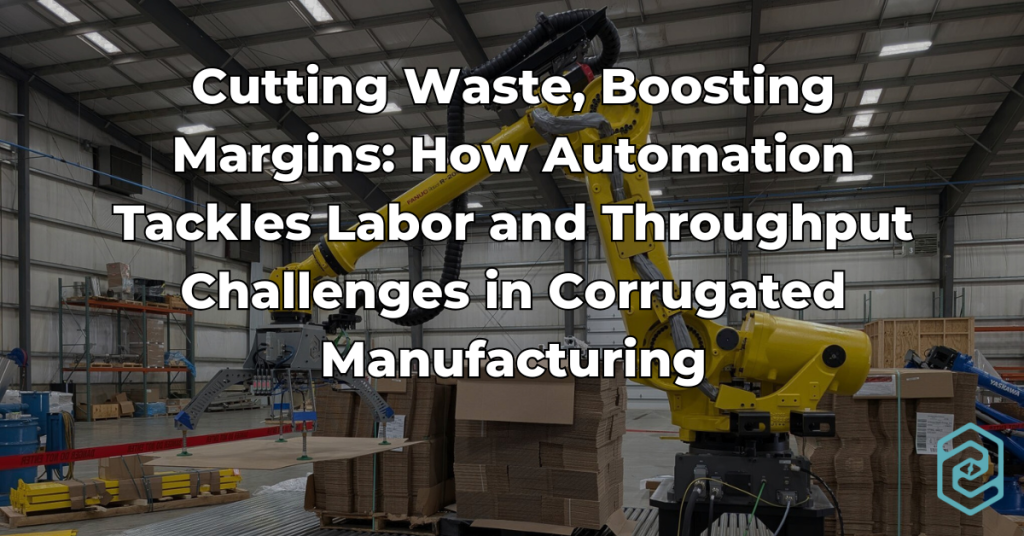
Corrugated manufacturers are under pressure like never before. Rising labor costs, workforce shortages, and production variability are eating into margins. Every stop, scrap, or rework cycle chips away at profitability — and manual tasks at the end of the line are often to blame.
That’s where automation steps in. By replacing repetitive, labor-intensive jobs with robotic systems, manufacturers can keep throughput steady, reduce errors, and free up people for higher-value work. One of the most effective examples of this shift is automated dunnage placement.
The Challenge: Manual Dunnage Placement
In many corrugated plants, dunnage placement remains a manual task. Workers must choose the right dunnage and apply it to units of varying sizes to protect products as they move downstream—a process that is time-consuming, ergonomically challenging, and often inconsistent.
The impact is twofold:
- Throughput bottlenecks when workers can’t keep pace with the line.
- Packaging variability that results in extra rework or dissatisfied customers.
When labor availability is tight, keeping this task fully staffed becomes an even greater challenge.
The Solution: Dunnage TopBot
20/20 Robotics’ Dunnage TopBot eliminates these challenges with a fully automated system for dunnage placement at the final station.
- Labor savings: Removes a manual, repetitive job from the line.
- Consistency: Every unit receives the same precise placement, improving downstream efficiency and presentation.
- Throughput protection: Keeps the line moving, even when labor is short.
- Speed & throughput: The system handles over 200 units per hour, with dunnage placement cycles completing in about 15 seconds.
- ROI focus: A single automation investment delivers long-term savings and measurable operational improvements.
By standardizing a critical finishing step, manufacturers not only reduce waste but also protect their margins in an increasingly competitive market.
Why It Matters Now
With labor costs climbing and skilled workers in short supply, manufacturers can’t afford inefficiencies. Automating manual packaging tasks like dunnage placement ensures:
- Predictable output, even in tight labor markets.
- A professional, consistent finish that strengthens brand reputation.
- Flexible labor allocation, allowing teams to focus on higher-value tasks.
FAQs About Dunnage TopBot
Q1: How does the Dunnage TopBot integrate with existing corrugated lines?
A: The system is designed to fit into the final station with minimal disruption. Our team tailors integration to your current line setup, ensuring smooth adoption without extended downtime.
Q2: What types of dunnage can the TopBot handle?
A: Dunnage TopBot is flexible and can be programmed for a wide range of sheet sizes, placements, and configurations to meet customer-specific requirements.
Q3: How does Dunnage TopBot improve ROI compared to manual labor?
A: By reducing labor costs, minimizing errors, and increasing throughput, most customers see payback within a short period. The savings scale as production grows.
Q4: Can the Dunnage TopBot adapt to different product runs?
A: Yes. The system combines input dimensional data with machine vision to inspect and measure the product, then selects the optimal dunnage to provide maximum coverage.
Q5: What support does 20/20 Robotics provide after installation?
A: We offer full training, programming support, and ongoing service to ensure your Dunnage TopBot continues to deliver reliable results year after year.